Battlefield Guide Services

Thursday, September 26, 2013

NOT Lincoln at Gettysburg: One More Clue

      Click on these images for larger viewing.
     After another day of continued debate and further scrutiny, I will offer one more item that I think will help settle this. Let's look once more at the Gardner image that Christopher Oakley suggests shows Lincoln, seated, in his top hat. My post yesterday points out that this "Lincoln" is seated behind and to the left of the center stage where it is reasonable to assume the POTUS would be seated. I have indicated Oakley's "Lincoln" with the big red "O". Move your eyes up and to the left. I have placed a white arrow pointing down to a man standing on a higher elevation, wearing what is a more casual slouch style hat, compared to those seated and to his front in top hats. Make note of the top hat figure directly to his front. Also note the higher figures to his rear and right.

     Below, I have enlarged the slouch hat man a little more. His top hat wearing neighbor is partially cropped out of the view, to his left. Note a white shape that suggests an exposed shirt collar below the profile.

     Moving on now to a detail from the image taken from the approximate front of the speakers' platform by another photographer. I have placed a white arrow pointing down toward an elevated figure in a slouch hat and a largely exposed white shirt collar. Partially concealing him in front is one of numerous men wearing ceremonial sashes. He has taken his hat off at this time. I suggest he is the same man in the previous Gardner view that was to the front left of the slouch hat man. Notice to the right, seated, is one of what is a cluster of men in top hats, more clearly seen in the fuller detail below this one. I am suggesting that this cluster of top hatted men is the grouping seen in the Gardner image where the "Lincoln" is supposed to be seated. By seeing these two images, known to be taken at approximately 60 degrees from each other, we can place the slightly elevated figures in relation to the seated figures and in the larger detail, see where Lincoln truly is seated, further off to the left and in what would be the center of the platform.

     Below, the larger detail shows the cluster of men in top hats, off to the right, with our elevated friends rising to the left, and gradually sloping back down, all the while essentially forming a semi-circle around the President who is seated, bareheaded, to the left of center, above the heads of the audience in front.

      And in closing, to supply a few requests for some indication of the camera positions in relation to the speakers' platform, here is an aerial view with red lines from each camera position pointing directly to the platform. The yellow line indicates the approximate 78 yard separation between the two photographers.
The camera positions are placed according to the map created by William Frassanito in his book, Early Photography at Gettysburg, page 139, and are approximates.


Wednesday, September 25, 2013

The Clue That Should End the "Lincoln at Gettysburg" Question

As with all images on this blog, please click them for larger, detailed viewing.

     Yesterday's hoopla regarding the supposed discovery of a new Lincoln image at Gettysburg is continuing to cause a stir along the media and blogosphere. One consideration that I realized I left out of my prior analysis, was the simple fact that Christopher Oakley's "Lincoln" is sitting behind other attendees, rather than sitting in the prominent front row where one would have to assume the President of the United States would justifiably be seated. Below, I present as I did yesterday, a detailed enlargement of the Alexander Gardner image, annotated with a red "O" over the head of Oakley's "Lincoln". The red X is the point of focus for the encircling spectators.

     An even further enlargement, below, shows quite clearly that the Oakley "Lincoln" is seated with head meekly bowed, at least one row behind what is the apparent stage front, mixed in with other similarly dressed men, all in tall hats and dark coats. Why would the POTUS be seated there in a subservient position? He would not.
     Now, let us look again at the other image taken that day by another photographer, from another angle, perhaps roughly 61 degrees, and about 78 yards slightly northeast from Gardner's camera platform. These estimates are based on mapping created by William Frassanito in his book, Early Photography at Gettysburg, page 139.
     Lincoln is clearly visible, and that has been long established. I have placed an "L" over his head for clarity. Notice if you will, to the far right of the cropped image, there are numerous rows of seated men wearing top hats, behind the two bareheaded gentlemen and a young boy. I submit that it is this grouping of men in hats that we are seeing in Gardner's images, elevated and behind the front row where the President is seated.

Done.


Tuesday, September 24, 2013

Another Grasp to Find Lincoln at Gettysburg Looks Questionable

Readers of this post will need to click the pictures below for detailed viewing.
     Former Disney animator Christopher Oakley has been recently written up in Smithsonian Magazine and in the USA Today. Both articles are publicizing his assertion that the distinct profile of Abraham Lincoln is now correctly "discovered" within Alexander Gardner's stereo views captured on November 19, 1863.
     Readers of this blog will recall my February post debunking the Center for Civil War Photography's claim to finding a "saluting" Lincoln within Gardner's views.
     I will go on record here, doubting just as strongly, Oakley's claim. In the detailed view below, I have annotated the location of the CCWP director John Richter's "Lincoln", with a red 'R". Oakley's with a red "O". And, to right of center, I have placed an "X" to indicate the apparent center of focus for the surrounding spectators. No one seems to be paying attention to either of the suggested Lincolns. Please click the images for larger viewing. 

Below, an even closer detail of the scene demonstrates the lack of attention to the Oakley "Lincoln",
 marked "O". The point of apparent concentration by the surrounding spectators is marked "X".

     Below, a detail from another photograph taken from a different angle, shows a much more focused attention by the crowd on a seated figure, long accepted as being President Lincoln, marked just above his head with a red "L". A stark contrast to the seemingly ignored figure seen in the above detail.


All images are available for even greater scrutiny on the Library of Congress website.


Monday, September 2, 2013

Harvest of Death - No "Third Corps badge" here folks

     I have no intention of rehashing all of my previous Harvest of Death material in this post, the reader can easily find that material here in my back catalog and review it themselves.. The purpose here today is to present a very simple visual dispelling of the long rumored suggestion that these dead are members of the Federal Third Corps. It is an issue that many continue to inject as "proof" that these honored dead are not members of the First Corps as Scott Hartwig, and myself, have demonstrated. It has even been suggested by William Frassasnito, in print, that the suspected "Third Corps badge" could very easily be something else, such as a cartridge box tin. Well folks, for your visual inspection and peace of mind, I shall illustrate that indeed, without a doubt, the item in question is a tin insert from a cartridge box. Take a look:
Here is the full plate image of A Harvest of Death.
Below, is a detail, with sharpened tones and contrasts,
showing at far left center, a diamond shaped item among
a pile of clothing and other debris. Click any of these 
images for larger inspection.
Now, below is another cropping of the suspect item,
seen at right of center. Note the clearly closed  
compartment of the upper tin, as well as the open lower half.
Here, look below at an actual cartridge box tin, 
positioned in pretty much the same orientation
as the one visible in the above image.
Also, for further size comparison, look at another item,
seen nearby in the detail below, an undisputed leather cap box.

See below, oriented in a similar fashion,
an actual cap box. Easy, right?
Next, let us compare the cap box in size relation to the tin.
Pretty similar in overall size. My point being here that, if
the diamond shaped item were a "third corps badge", it would
be the largest example, four inches across, point to point.
 Far larger than a regulation hat insignia.

Below let us look at the same bodies from the near opposite direction.
First from one stereo version by O'Sullivan...
...and in the other by Gibson. The suspect item is
at far right center now, among the assorted darker items.
Let's zoom in and take a closer look in Gibson's.
And now from O'Sullivan's below.
Be sure to click the images for
larger inspection.
Finally, see below the cartridge box tin,
oriented in the same fashion as the item
in question. Same features, closed upper
compartment, and open lower section.
NOT A THIRD CORPS BADGE

Are we all comfortable on that question now?


Tuesday, August 20, 2013

Additional Thoughts and Images on the McClellan "mystery"

     See my previous post from 8-19-13, for the complete story.

     Further delving into the happenings of March 1862 indicated a strong possibility that the meeting of General Morell with General McClellan took place on March 9 or 10, prior to McClellan moving the army and his headquarters to Fairfax Courthouse.  However, additional information has shown that the image of the General-in-Chief and accompanying officers was copyrighted on January 6, 1862, making the date of its being taken some three months earlier than suspected. Further details are presented in our October 2nd post.  By March, the Peninsula Campaign would be under way. Observation points such as Minor's Hill provided indication of the Confederate withdrawal from the Fairfax and Manassas region.
     Below is a detail from a view said to be the "Miner House". The Library of Congress source states the location is "Petersburg, Va" although a second source in the MOLLUS-Mass collection of the U.S. Army Heritage and Education Center is titled Miner's House, Miner's Hill, Va.  Click on any image for larger viewing.
     Take special note of the dark sign on the wall next to the right hand window, and compare it to the one seen in the image below, at the extreme left of the print from the LOC. That, along with the fence like rail and other features of the building make it doubtless the same structure. Knowing that this is indicated to be the headquarters for General George Morell, we can rule out this is Petersburg altogether since Morell was no longer in a field command position after the Antietam Campaign. Numerous sources state the location is "Miner's Hill", near Falls Church. As stated before, the spelling "Miner" is a common misspelling of the day for "Minor", the name of the property since the late 1700's. The area today includes the Franklin Forest and Franklin Park neighborhoods, near the western Arlington County line.
     The complete view of the Signal Tower is shown below. It is identical to the one in the image with General Morell, and perhaps taken around the same time as the McClellan visit. It is also worth noting in the background of the above image, there are arches decorated with greenery, an ornamentation used in the entrance to company streets in many camp situations. We will see this feature again in another image later.

      Take note of the features of the building visible in the right hand portion of the image below. It is the same structure as above, clearly identified as the Minor House, on Minor's Hill, Va.

     Take note of the decorated arched in the background of the photograph below, depicting the camp of the 17th New York Infantry in review, at Miner's Hill, Virginia, vicinity of Falls Church. Very much like the arches seen in the identified photograph of General George Webb Morell at the Minor's Hill Signal Tower.
     Finally, below, here is the copy from the MOLLUS collection, USAHEC, identified as the Miner House on Miner's Hill, Va., not Petersburg as misidentified with the LOC negative. I see no further doubt that the "mysterious location" of the McClellan image is solved. 


Monday, August 19, 2013

McClellan Mystery: Can we put it to rest? Photo taken at Minor's Hill, March 1862.

     My readers will hopefully excuse this wandering off the path regarding Spotsylvania and it's surrounding engagements. Today's post is a quick trek up the road, north to my old neighborhood, so to speak. The outskirts of Washington, D.C.
     I believe this post will correct one misconception regarding the first attached image, and secondly, solve an ongoing mystery.  The mystery involves the very obvious visage of General McClellan. All indications appear to point to an identification of it's location as being "Minor's Hill", roughly two miles north of Falls Church, Virginia, during a visit to the headquarters of Brigadier General George Webb Morell, a division commander of the Union V Corps. The problem in identification has in places suggested that the man to the left of McClellan, with knuckles also on the stump, is General George Gordon Meade. This man is indeed similar to Meade, but there is a lack of Meade's trademark comb over and the absence of Meade's distinct tortoise eyes. The brigadier general seen here is in fact George Morell, and is so identified on this version. Click on any image for larger viewing.


     Notice the man behind Morell, standing with his arms folded. He is identified in this version of the image as "Surgeon Walters" Notice then in the image below, the man pointing at center is identified as General Morell, this time wearing his cap. Look now, two men to the right of Morell, and you will see Surgeon Walters, again, with his arms folded. Both images are in the Library of Congress collection, identified as Minor's Hill, although misspelled as "Miner's". This location was a large camp and observation area for the Union Army, as well as the location of numerous hot-air balloon ascents to observe Confederate movements to the west. The date for these images is apparently in March of 1862 while McClellan was headquartered at Fairfax Courthouse, roughly 9.25 miles to the southwest. (See update in our October 2 post by clicking here.) The structure seen in each image may in fact be the same. Notice the large observation tower that is known to have stood at this location. The location today is somewhere along the Fairfax County and Arlington County line, amongst wooded subdivisions, with no indication of identifiable cultural resources to pinpoint the exact spot, although chances are the tower was placed on the highest point on the hill. 
Updated August 2016
Exact location found. Structure to be demolished for new homes.


Links to the LOC for each image are located here, and here.

Monday, July 1, 2013

Podcast: The Battlefield Photography of Dr. Reed B. Bontecou

     Earlier in the year I gave a talk on the post-war battlefield photography of Union Surgeon, Dr. Reed Brockway Bontecou, in Charlottesville, Virginia. This is material I have been working on since 2004, revealing the origins of a stereoview series previously credited to a mysterious Baltimore photographer, G. O. Brown. Click the link to listen to a podcast recording made that evening. 
link - The Battlefield Photography of Dr. Reed B. Bontecou
There is an audio flaw at 12:36 minutes into the program. Not certain what happened there.
Below are a few of the images discussed during the presentation.
Click on the images for larger viewing.

     One of eight images of Dr. Bontecou within the series. Detail from a stereo card in the collection of Robin Stanford, with permission. Bontecou is standing in front of Confederate breastworks near the Orange Plank Road.
A later, published portrait of Dr. Bontecou for comparison purposes. Note the distinctive beard.

The sign on the "hacked and barkless trunk". Note the bullet holes peppering the surface.
April 1866.

The detail from the left horizon line revealing the McCoull House on the Spotsylvania Battlefield.
The discovery of the structure in the image was vital to locating the series on the ground
The other view of the same sign and tree creating the triangulation that helped locate the original camera positions. April 1866.

The same view today, showing the earthen parapet extensively eroded.

One of the "G. O. Brown" stereoviews, showing skeletal remains in the Wilderness. April 1866.
Collection of the author.

Shallow graves of dead Confederate soldiers beside the Orange Plank Road.
April 1866. The skull at center resides in the Armed Forces Museum of Pathology Collection,


Monday, June 10, 2013

Brandy Station 150th Anniversary, June 9, 2013

     One hundred and fifty years ago yesterday, over 17 thousand horsemen clashed near Culpeper, Virginia at Brandy Station, on the Orange and Alexandria Railroad. This would result in a day long struggle, becoming the largest cavalry engagement on the western hemisphere, leaving 1,430 killed, wounded, missing, and captured. Above, the view looks northwest, toward the site of the 12th Virginia Cavalry's advance against the right flank of the 6th Pennsylvania Cavalry. Click on this, and any image for a larger examination.
The 6th Pennsylvania Cavalry charges across the open field towards Confederate artillery massed near Saint James Church. From a newspaper sketch by Alfred Waud, in the July 4, 1863 issue of Harper's Weekly. The entire issue can be examined visiting a link by clicking here.
      That field is today preserved thanks to Herculean efforts by preservation groups, thwarting such insensitive encroachments as the construction of a proposed Formula One race track.
The site of the Saint James Church, dismantled by Union soldiers
 for building materials during the winter encampment after Gettysburg. 
Site of the left flank of Confederate artillery positioned on the Saint James Church ridge, looking east.
The only historical marker on the battlefield prior to advances by battlefield preservationists.
 Twenty-three years earlier, in June 1990, Brian Pohanka spoke at a Brandy Station Foundation rally on Fleetwood Hill. Seen in the left background, in the red stripe blouse, is preservationist Annie Snyder of Manassas battlefield fame. Both are now departed, but the battle for hallowed ground continues.
The Henry Miller House, on Fleetwood Hill. Here seen as Union 3rd Corps headquarters in 
the spring of 1863. Notice the large patches of  snow still visible on the ground.
     Fleetwood Hill today. The focus of a current fund raising campaign by the Civil War Trust. The Miller house stood just to the left of the modern structure, based on Civil War era maps. Confederate General Jeb Stuart maintained his headquarters on the lawn, just to the right of the modern house. 
     "Farley", the home of Dr. William Welford, situated on the northwest extreme of the battlefield. Virginia cavalrymen swept across the property late in the day, pressing  a weary Union force back toward the Rappahanock River crossing at Beverly's Ford. During the winter of 1863/1864, Union Sixth Corps commander, John Sedgwick made his headquarters here. It was photographed in March 1864.
 Image from the collection of the Library of Congress Prints and Photographs Division.
Today, Farley has been beautifully restored and is maintained as a private residence.
General John Sedgwick stands at front center with members of his staff. Photographed March 1864.
Image from the collection of the Library of Congress Prints and Photographs Division.
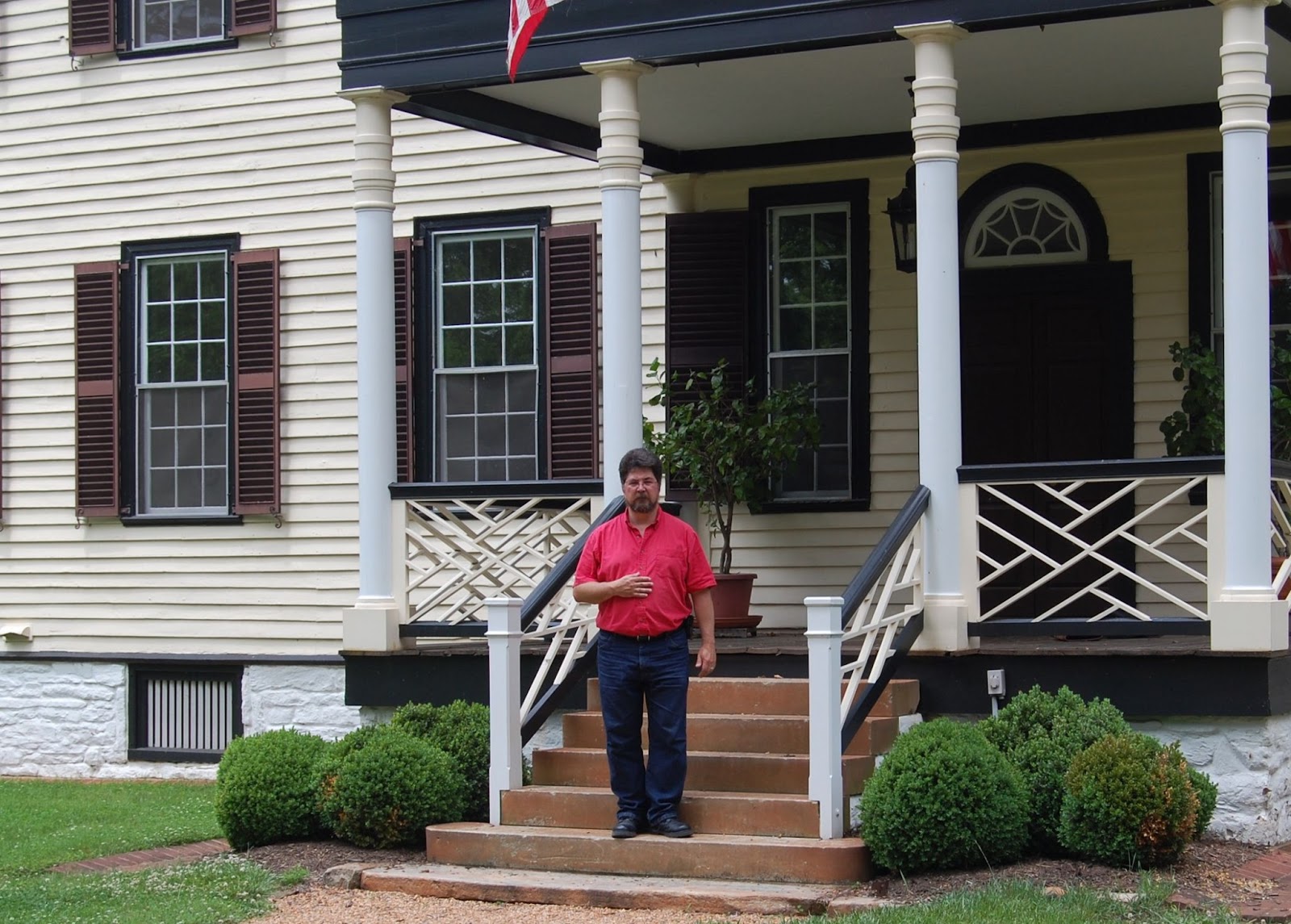
     Now, 222 years old, Farley maintains all of its grand character. Here your blog host strikes a pose in memory of General Sedgwick who lost his life on May 9, 1864 during the battle of Spotsylvania Court House, just two months after the previous photograph was taken..
 On the east lawn of Farley, Sixth Corps staff officers gathered in front of a temporary winter hut.
                 Image from the collection of the Library of Congress Prints and Photographs Division.
     The same view as it appears today. The armies have gone, and peace is on the land.