Battlefield Guide Services

Wednesday, July 20, 2011

Bull Run Remembers 7/ 21/1861 - 7/21/2011

Thursday, July 21st will be the Sesquicentennial anniversary of the battle of First Bull Run/Manassas. The National Park Service is holding the official ceremony on Henry Hill, seen at the right distance in the March 1862 photograph below.
In 1961 my father attended the Centennial commemoration  of the battle and the reenactment held on Henry Hill. I was not quite four months old, and I stayed at home with my mother so as to not fry my infant brain in the extreme July heat. My father took a roll of color slides that day, which enthralled me as I grew up looking at them in a hand held viewer. Coupled with living in a house full of history books, it was a sure thing that I would have a deep rooted appreciation of our National heritage.

The backlit Pana-Vue slide viewer above, and one of the slides
showing Confederate reenactors forming up for the big show, below.

Below is one of my favorite books about the battlefield, written by the pioneering superintendent of
the park, Joseph Mills Hanson. It is still in print today and a must have for any library on the subject.


I shall report back on Friday with a follow up on Thursday's events. I have waited fifty years for this.


Thursday, July 14, 2011

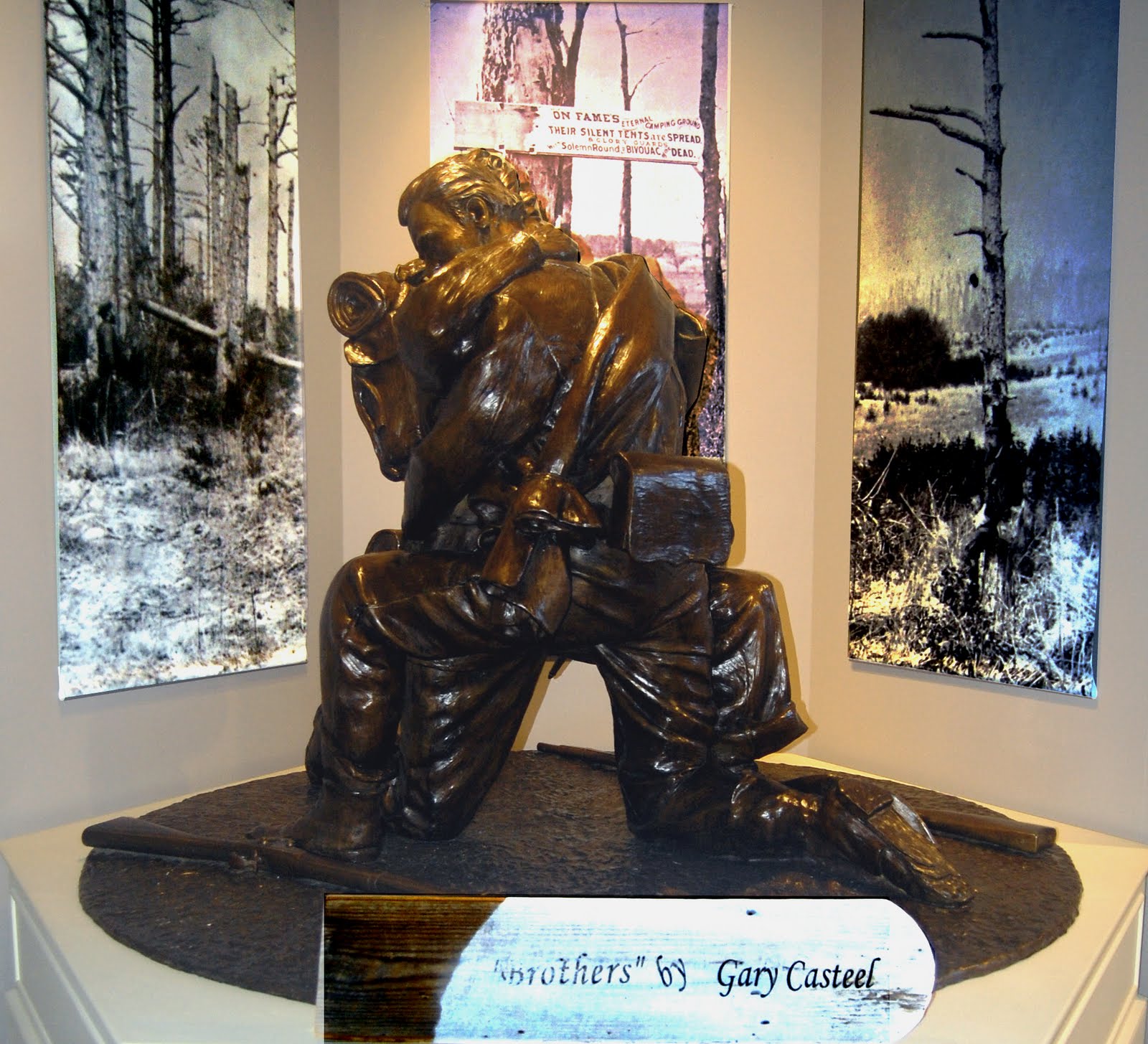
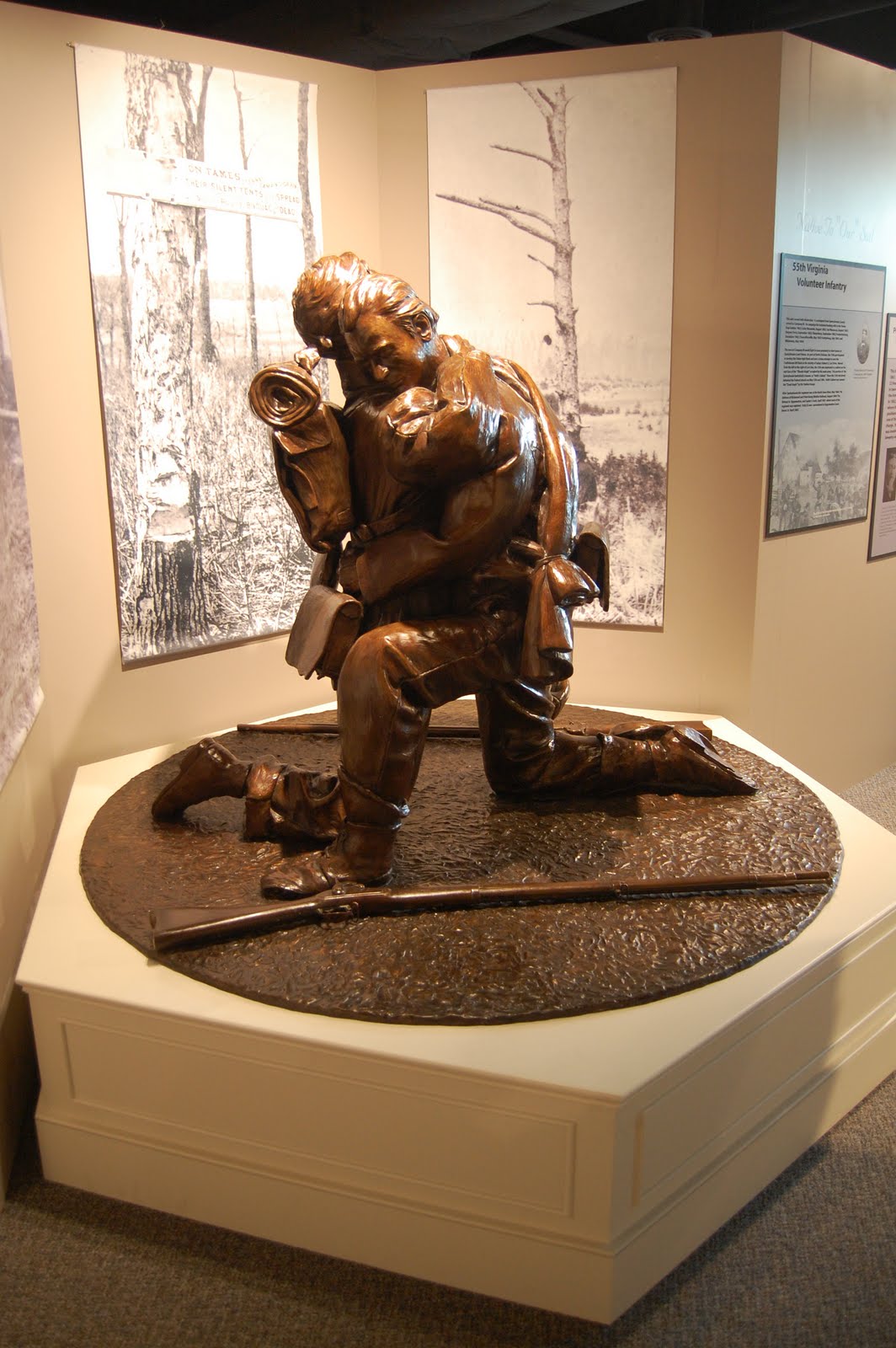
Sculpture's "Twin", Depicting Reconciled Brothers, Resides in Spotsylvania Museum

Whereas a sculpture by artist Gary Casteel entitled "Brothers" was placed in the Virginia State Capitol on Monday July 11, its identical twin has resided for nearly two months in a recently opened satellite of the Spotsylvania County Museum. The Museum enjoyed a "soft" opening during the re-enactment weekend of May 21-22, 2011. The official grand opening is slated for later this month.
The Richmond "twin" has received extensive commentary in newspaper and Internet media over the past few days since its unveiling. The sculpture is intended to commemorate a reconciled nation during the Sesquicentennial observance of the Civil War. Rather than spell out the resultant debate that has exploded over a well intentioned gesture, I will provide the following sample site links, right here, here and also here.

The new Spotsylvania County Museum is located at 9019 Old Battlefield Boulevard, 1st Floor, in the Merchant Square Building.
The new County Museum entrance.
It is open Wednesday - Monday 9-5.


Click on any of the photographs for enlarged viewing.

Sunday, July 10, 2011

NPS Summer Staff Member Brings Civilian Story to Life at the Sunken Road

As reported by NPS historian Eric Mink at Mysteries and Conundrums here, summer staff member Katie Logothetis is presenting "first-person" programs along the Sunken Road Saturdays and Sundays only at 11:15, 12:15, 2:15, and 3:15.

My wife and I attended yesterday's 2:15 performance and were delighted.  The program brings the civilian refugee experience of Fredericksburg to life in a comfortable 15-20 minutes. The research and writing of the program's content was done by the Park's Chief Historian John Hennessy, but Katie makes it her own with a smoothly articulated and confident delivery. The experiences of diarist Mary Caldwell is a must see this season. Even if you have visited the park many times over, this makes stopping by again well worth it.

Katie Logothetis as Mary Caldwell.

Friday, July 8, 2011

A New Look at a Fredericksburg Burial Trench

While recently examining the two Brady & Company images that together make an extraordinary panorama of the "open plain" battleground of Fredericksburg, I began to consider numerous points of interest that fall within the confines of its cone of vision. It is both sad and remarkable that in the post Civil War years, Fredericksburg, the town, began to expand into a sizable city and consume, perhaps cathartically, the landscape that became one of the most horrifying places in American memory. To stand on the ground today, amidst the residential and commercial structures that now fill the former vastness, it can be difficult for visitors to visualize just how suicidal and ill-conceived the frontal assaults were that December day. Coupled with the fabled stories of urban street fighting, it is hard to decipher where the 1862 town ended and the open ground to the west began, at least in the mind's eye. With the help of these images, and the scattered landmark structures that have survived to this day, we can walk the modern streets, like trying to conquer a labyrinth, and gain some perspective of a once near desolate landscape.

To create the panorama, the two images must be placed to overlap.
The left edge of the brick structure's roof provides a focal point.
The horizon line will come together where the Marye mansion sits.
Click images to enlarge for greater detail.

Some of the most poignant scars the war left on the terrain have been erased, if only to be redrawn in a more fitting location on Willis Hill. I refer to the original burial trenches that contained Union dead from the December 1862 battle and later those who did not survive wounds received during the Spring Campaign of 1864. I will discuss the latter in a future post. Here I will focus on what I believe is visible within these images.

In his now classic two-volume work, Fredericksburg Civil War Sites, National Park Service historian Noel G. Harrison presented documentation as to the nature and the location of these grim features. In referring to the "easternmost north burial trench", Noel provides a post-war recollection, quoted from a Confederate officer, Captain C. H. Andrews, who had witnessed the site first hand in January 1863:

"A short distance nearer the city and where the open field made a sudden dip or step, was a line of earth-works, thrown up hastily as a protection against the bullets of the Confederates, and in this earth-work defense dead horses were placed, and with them had been laid the bodies of dead Federals, for here and there the legs of horses and arms and legs of soldiers were thrust out, and overall loose dirt was piled up, intended to cover and bury them. It shocked us greatly -- the inhumanity to brave, dead and now helpless comrades."

The "sudden dip or step" is a strong clue toward identifying this position on the ground. The only place along the plain that best fits that description is on the south side of Hanover Street, and east of Weedon Street. Reinforcing this belief is what I believe is photographic proof, seen in the panorama images. Seen atop the edge of the hill that is today above Lee Avenue, there appears to be a dark line, a berm, that runs between Hanover and the location of modern Mercer Street. Basically it looks as if it hugs the lip of where west bound waves of Union soldiers would have topped the hill and sought to achieve cover from the gunfire raining down on them from nearly 375 yards away, well within the effective killing distance of the rifled muskets of the era. The ground behind (coming back toward the camera position) has been terraced and manicured as residential property today. Looking up at it from the Hanover Street intersection with Kenmore Avenue, one can imagine the desperate struggle all along the battlefront. Another 187 yards to their slight left oblique, stood the lone Stratton House, behind which other wounded and desperate men had begun to huddle for safety. A white line running from in front of the Sisson Store, running southerly toward Stratton, is a road that follows present day Littlepage Street, roughly 182 yards ahead of the trench.

From the left hand glass negative, the detail of the likely burial trench is
indicated by the white brackets placed at either end. Click image to enlarge. 

The horizontal white line between Weedon Street
and Lee Avenue indicates the approximate
location of the burial trench, based on the 1864 photographs.
The yellow horizontal line indicates a previously suggested location.
Click to enlarge for greater detail.

The "sudden dip or step" as seen from the intersection of Hanover Street
and Kenmore Avenue, the location of the "old mill race" or "power canal".
Lee Avenue runs on a diagonal toward the left, below the step.

Supplement Please review the comments section of this post and read the message sent by NPS historian Noel Harrison, and my reply. Find below the map drawn by the Pennsylvania soldier that Noel refers to. Click the image to enlarge.

Friday, July 1, 2011

Gross! What Are They Doing? Latrine at the Fredericksburg Power Canal? A Not So Pleasant Consideration.

Early this morning, while looking through a digital collection of Civil War images from the National Archives, I found a curious detail that I don't recall noticing before. The NA images are scanned at only 300dpi, far less than the Library of Congress Collection, but being originally 8 X 10 glass negatives, there is still a good bit of detail to ponder when enlarged. The particular photograph I examined is the left half of a well known panoramic pair (taken in May 1864), showing the notorious open plain at Fredericksburg. Looking along the left middle ground I traced the water power canal that had served as an obstacle in the Union's December 13, 1862 assault of Marye's Heights. Near the left side of the image there appear to be at least seven and perhaps up to nine or ten soldiers (one has to assume), most in shirt sleeves, probably attending to the call of nature or are about to. It seems like a rather remote location, some 180 yards distance from the camera, which was in the yard of the house known as Federal Hill on Hanover Street. Please, click directly on the image to enlarge for greater detail. I have placed markers over the seven most possible figures.

We can not know if these are wounded men from a nearby hospital or if they are simply men stationed in town, but they do appear to be there. I could be wrong in suggesting they are at toilet, but one figure, sixth from the left, looks to be squatting in the recesses of the ditch. In fact, three in the image appear to be squatting while two others at least look like they are about to or are standing back up. Their random positions make it very curious. The fourth and possibly fifth figure from the left look as if they are standing, looking at the camera, possibly.  The fifth figure looks also to be wearing a jacket, or a dark shirt. If this is indeed depicting a toilet area, with such random positioning of those using it, it must have been a horrible place to venture to, full of sickening potential for missteps. The full image is seen below. Please click directly on the image to enlarge.


I'd like to credit National Park Service historian Noel Harrison for providing the link to this collection of National Archives scans. It is available to examine at the link provided here.

Monday, June 27, 2011

My Newest Book - Released Today - Spotsylvania County

I would like to let my readers know that today is the official release date of my latest book, Spotsylvania County, published by Arcadia Publishing of Charleston, South Carolina. If you live in the Fredericksburg/Spotsylvania region it will be available in many local outlets. I will be doing signings over the 4th of July weekend, at the Spotsylvania Courthouse area and in downtown Fredericksburg. Also, if you are local and would like to pick up a copy ahead of time, or reserve one from the stock I have on hand, please send me an email. I have also included a direct link to order from my publisher at the right hand side of the blog. I have included over 200 images, many never before seen in book form. 128 pages. The retail price is $21.99.


Highlights from the book include:
1. The story of the formation of the county and its namesake Alexander Spotswood.
2. Photographs of structures no longer standing in the community.
3. Photographs of structures that have withstood the test of time and war.
4. On-site sketches by newspaper artists that witnessed the Civil War’s battles and their aftermath.
5. Photographs of local citizens that endured the hard times of post-war recovery.
6. The story of the memorials placed to honor those who fought here.
7. Highlights of the formation of the National Battlefield Park.
8. The local experiences of the Civilian Conservation Corp during the Great Depression.
9. Visual reminders of the Civil War still impressed upon the landscape.
10. Preservation efforts and the regional approach to good stewardship of historic and cultural resources.

The book is an honest assessment of a community dealing with a historic past not so warmly embraced. The Civil War was a debilitating, horrific period that left the region deeply scarred, socially and economically. To this day the County hesitates to commit resources toward encouraging tourism as a viable means of generating revenue.

Here is my author's bio from the new press release:

John F. Cummings III, 50, is originally from Fairfax County, Virginia, where he developed a lifelong passion for history, particularly the Civil War era. He moved to Spotsylvania in 1999 with his wife Karen, living on land that saw action during the Overland Campaign of 1864. Before moving south, John had worked as a Loss Prevention Auditor for a major DIY retailer in the National Capital Region.

A researcher and writer, John’s specialty is image analysis. His work as a visual historian has been published in national and local publications.

John was a member of the former Spotsylvania Courthouse Tourism and Special Events Commission, and serves as chair of the Friends of the Fredericksburg Area Battlefields, providing assistance to the National Park Service through support of educational programs, films and publications.

John spent his first decade in Spotsylvania documenting the local efforts of preservationists during one of the most active periods of battlefield encroachment by developers. He has witnessed the County government attempt to strike a balance between good stewardship and respect of personal property rights, all the while trying to maintain a sufficient tax base.

Thursday, June 23, 2011

Computer-Aided Forensic Facial Comparison Removes Doubt of Alsop Image

After much speculation and debate, there seems to be an answer in the case of the "Susan Alsop" photograph discovered in the attic of the Alrich house in Spotsylvania. See the original post here. Is this an early portrait of Susan M. Read Alsop, widow of James Addison Alsop?


I would have to give an emphatic "Yes" based on caparison to a known post-war portrait kindly supplied by Alsop family genealogist Jerry D. Alsup. Jerry is currently working on volume three of his monumental family study, Alsop's Tables. The first volume was published in 1986 with the second volume following in 1994.


This identified image shows Susan M. Read Alsop sometime in the 1880s based on her clothing. She would have been in her 40s during that decade. The earlier image of which we have been uncertain shows a young woman dressed in the fashion of the 1850s. Susan M. Read Alsop was born on September 25, 1840.

I took both images and produced a superimposition to compare facial features. I was delighted to see an easy comparison of the craniofacial landmarks. At 50% transparency it is clear that there are no readily apparent deviations in the placement of the eyes, nose and mouth, suggesting very strongly that they are of the same woman with perhaps a separation of three decades. Both images even show a possible asymmetry of the nostrils, her left appearing larger than the right.


The only remaining questions regarding the older image would be as to how long prior to her marriage to James Addison Alsop was it taken, and who may the image be in her broach? One thing is probably most certain is that this was not an image of her in mourning following James' death in December 1860.
There is also the question as to how she was related to the Alrich family? Her son, John Addison Alsop had been married to Florence Chartters, a relation to the Chancellor and Leavell families. Hopefully the connection will become apparent soon.

Tuesday, May 31, 2011

"Sue Alsop" Photograph May Not Be Actual "Widow" Alsop of May 19, 1864 Battlefield

See the more current post above that removes the doubt expressed here. The woman in both images is Susan M. Alsop, more famously known as "The Widow Susan Alsop".

Second update: An Anonymous comment to this post, added 12/4/2011, points out the widow Alsop's obituary in the Daily Star, December 6, 1915. That obit clearly states that she died  "peacefully at the residence of Mr. S.R. Alrich". This may indeed be a clue as to the connection with the Alrich family. That clue had remained embarassingly unobserved by your blog host until this anonymous tip. An immediate assumption would make this "Mrs. S. R. Alrich" to be Annie, the wife of Samuel Alrich, but his middle intitial was "W" according to census records. Those fine details remain still uncertain, but there is now a good indication that Susan M. Alsop was at least a friend of the Alrich family, possibly considered an "Aunt", as many times older friends of a family are called "Aunt" or "Uncle" by children even if there is no blood or marriage connection. We shall persevere.

After a good deal of consideration, I am more and more suspecting that the image from the previous post, despite many people's hopes, is not THE Susan Alsop. My major concern continues to be how it would have become part of the Alrich family collection of memorabilia. So far there is no readily apparent family connection. With many factors to bear in mind, this photograph may actually be of Susan Jane Beazley Alsop, from the other side of the battlefield. This would account for the 1850's clothing more easily than it being Susan M. Alsop.

More if and when we can determine something.

Tuesday, April 5, 2011

Is This The Widow Susan Alsop? A treasure from the attic.

     When retired museum professional Terry Dougherty entered the attic of the Alrich house near Spotsylvania Courthouse, he knew he had stumbled upon a goldmine of Spotsylvania genealogical material. Last summer, Dougherty paid a visit to the house and Alrich descendant John Alrich-Altman. The majority of the home's contents had been sold off in an estate auction in June, but the attic had remained untouched and as it turned out, packed with an archive of historical images and memorabilia of the family. Many of the items are now on temporary loan to Spotsylvania County for a museum exhibit being prepared by Dougherty as a volunteer to the County. It is a Herculean effort, but one that Dougherty relishes. The display is scheduled to open in late May of this year in the Courthouse Village government office building.
     Perhaps one of the most intriguing finds was a photograph with the inscription, "Sue Alsop, Old Aunt, a lovely Christian woman". Immediate speculation is that this is a photograph of the matron of the Alsop Farm of the May 19, 1864 battle fame. Susan M. Alsop was only twenty-one in December 1860 when her husband James Addison Alsop died from the effects of a carriage accident. Susan and her six month old son, John, continued to live on their Spotsylvania farm, witnessing the horrors of battle virtually on the threshold. Susan lived out her days there until she passed in 1915. This copy of the photograph may in fact have been made as a memorial keepsake for family members in 1915 as it is an enlargement of the 1860s period original, mounted on a "cabinet card stock", typically done after the turn of the century for such purposes.
The image of "Sue Alsop", enhanced and restored from a
scan of the original by John F. Cummings.
The inscription on the back is shown below.
     The interesting features of the photograph are the trappings of mourning etiquette that the woman is wearing, which taken by themselves are supportive of this being the "Widow Alsop". She is wearing a photo broach of her deceased husband, pinned to her collar, a tradition of Victorian era mourning practices. Considering that the collar is white, this indicates that the photograph would have been made after the end of "Full Mourning", which was to last for a year and one day. In full mourning the widow was required to wear all black for the entire period. After entering second stage mourning, a widow could add some color to her clothing, usual a white collar and cuffs. This being second stage mourning would indicate that it was taken no earlier than late December of 1861. Considering the distance to photographers in Fredericksburg from her Spotsylvania home, it is even likely that the photograph was made in early 1862 with the arrival of weather conditions more hospitable to travel on country roads.
     It should be noted that the hairstyle this woman is wearing is typically that of the 1850s era, a style consisting of padded wings over the ears. If this is indeed THE Susan Alsop, widow of James Addison Alsop, one has to consider that she is wearing a hairstyle that would have been out of vogue by the early 1860s. This does not mean that she could not have opted to continue this style, but typically a young woman as she was then, approaching 23, would have been more inclined to keep up with fashion of the day.
     Further scrutiny will be required of this and the hundreds of other images found in the Alrich attic. We are fortunate that they have survived to provide a window into the county's past.

The south western exposure of the Alrich home,
(Dabney house during the Civil War), and the lone attic window.
Photographed June 5, 2010 by John F. Cummings.

Sunday, April 3, 2011

Stafford Post of April 2: Technical issue with images is fixed.

For some reason, the images in yesterday's post on the Review Site in Stafford County were displaying square, thus they looked compressed. I have corrected the problem and they should be easier to look at on the blog page now. They are still clickable for enlarged viewing.
Thank you for visiting the Spotsylvania Civil War Blog.